The last time the internet fundamentally changed underneath businesses, most of them didn't notice until they were already behind.
It was 2004, maybe 2005. Google had been around for years, but the real shift — the one where showing up on page one became existential for your business — crept up quietly, then landed all at once. Companies that had a website felt fine. What they didn't realize was that having a website and being findable on search had become two completely different things.
That same kind of shift is happening right now. Most businesses haven't noticed yet. By the time it feels obvious, the brands that moved early will have a structural advantage that's genuinely difficult to close.
It's called the agentic web. Here's what it is, why it matters, and what to do about it before you're already late.
The web keeps reinventing how people find things
Every decade or so, the fundamental mechanism of online discovery changes. The pattern matters because each shift created winners and losers — not based on who had the best product, but on who understood what the new system was optimizing for.
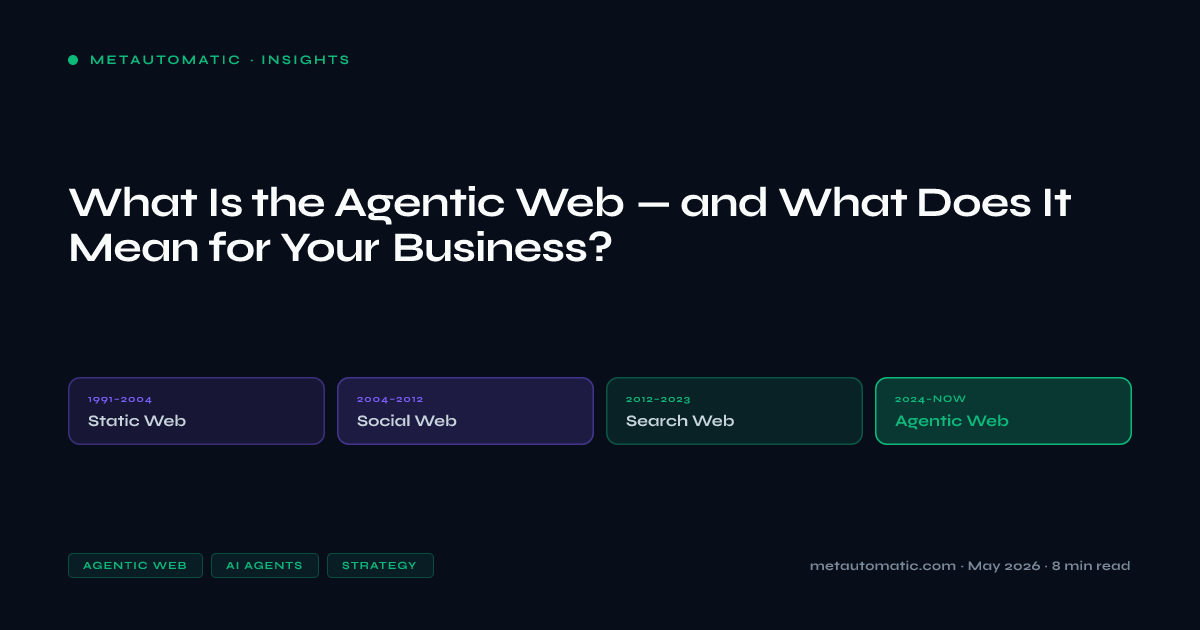
Web Evolution — Four Eras of Discovery
1991–2004
Static Web
You had an address. Discovery was directories and word of mouth.
2004–2012
Social Web
You had a presence. Discovery was feeds, shares, and followers.
2012–2023
Search Web
You had rankings. Discovery was Google-indexed content.
2024 — Now
Agentic Web
You need to be trusted. Discovery is what agents cite.
Each era rewarded different things. The social web rewarded engagement and virality. The search web rewarded answering questions well and building authority over time. The agentic web rewards something different again: being a source that AI agents trust enough to cite when they're answering on behalf of a human.
The rules changed. They always do.
What the agentic web actually is
Here's the simplest version: the agentic web is what the internet looks like when AI agents browse it on behalf of humans — not to read it, but to act on it.
When someone opens ChatGPT and asks "what's the best project management tool for a 25-person agency," they're not looking for a list of links to click through. They want an answer. The AI synthesizes information from hundreds of sources, evaluates the options, and returns a recommendation — sometimes with links, often without. The human may never see a search results page at all.
That agent made a decision. And whether your business is part of that decision — recommended, mentioned, cited — depends entirely on what signals the agent can find and trust about you.
Search engines indexed the web for humans to navigate. AI agents traverse the web to make decisions on humans' behalf. Visibility in one system doesn't guarantee visibility in the other.
This is the core shift: from humans clicking links to AI agents making decisions. And it changes almost everything about how online discovery works.
How agents actually navigate the web
This is where most businesses get confused, because agents don't work like search engines. They don't rank pages by keyword density. They don't care about your meta description. They're doing something closer to what a very fast, very thorough researcher would do — checking multiple sources, looking for consistency, and deciding what to trust.
How an AI Agent Answers a Business Query
Here's what agents are specifically looking for when they evaluate whether to cite a business:
- Structured signals. Schema.org markup,
llms.txtfiles, andagents.jsonare machine-readable files that tell agents what your business does, who you serve, and what you can be trusted to provide. Most businesses have none of these. Schema.org has been around for years — it just matters much more now. - Third-party corroboration. Agents don't just trust what you say about yourself. They look for consistent mentions across sources they already weight heavily. Reddit captures 24% of all Perplexity citations — it's community-verified information that agents treat as a trust signal.
- Consistency across the web. Agents are pattern-matchers. If your business name, URL, and description are slightly different on every platform you appear on, that inconsistency registers as a weak reliability signal. Consistent presence on Crunchbase, LinkedIn, Wikidata, and industry directories tells agents your entity is real.
- Authority signals. Citation by credible sources. Links from high-authority domains. The E-E-A-T signals that Google built into its algorithm overlap heavily with what LLM training data considers trustworthy.
What actually changes for your business
"The web is changing" is not actionable. Let me be concrete.
You can be invisible without knowing it
Search engines give you a ranking. You know if you're on page 5. AI engines give you nothing — they just answer without you. The only way to know if you're being cited is to manually ask these systems about your category and watch whether your name comes up.
We did this with Metautomatic when the site launched. Searched for "AI agent agency" and "AEO agency" in ChatGPT and Perplexity. We weren't there. Six weeks of deliberate work on AEO infrastructure — structured data, entity listings, community presence — and we started appearing in roughly 30% of relevant category queries. That number is trackable and improvable, but only once you know it exists.
Your website is now read by two audiences
Humans and agents both visit your site. But they read it completely differently. Humans care about design, copy, and whether it feels trustworthy. Agents care about your heading structure, Schema markup, and whether you have a llms.txt file that describes what you do in plain language. Optimizing for agents doesn't hurt the human experience — but ignoring agents while only optimizing for humans leaves half your audience unserved.
Some marketing channels just became much more important
Reddit matters in a way it never did for traditional SEO. A thoughtful answer in a relevant subreddit is more likely to get cited in a Perplexity result than a guest post on a mid-authority blog. LinkedIn company pages are indexed and cited. Community presence is no longer optional for B2B brands — it's infrastructure.
The buying journey is being compressed
When an agent can go from "what's the best accounting software for my size business" to a shortlist of three options in under ten seconds, the traditional multi-touch funnel breaks. Awareness and consideration now happen simultaneously, inside the AI response. If you're not in that response, you don't get a stage at all.
The early mover data
A lot of the numbers floating around about AI search are projected or extrapolated. But the directional evidence is consistent enough to act on.
The 3.4× citation advantage is the most important number here strategically. Citation advantage compounds. Once an AI engine has learned to treat your brand as a relevant, trusted source for a category, you appear in more queries. More appearances generate more engagement signals, which reinforce the trust. Getting in early is genuinely worth more than getting in well — because early movers define what "authoritative" looks like in their category before anyone else does.
There's also a measurement gap: only 16% of brands currently track their AI search performance systematically. The other 84% are flying blind. Which means the gap between brands that know their AI visibility and brands that don't is the same gap that existed between businesses with analytics and businesses without them in 2008.
Three things to do before anything else
You don't need to overhaul your entire marketing strategy this week. But there are three things worth doing now, before the window to move early closes.
1. Run a visibility audit
Open ChatGPT, Perplexity, and Google's AI Mode. Search for your category as a customer would — "best [your service] for [your target client type]." Do this for 10–15 different query phrasings. Note whether your brand appears, and where. This takes twenty minutes and gives you a baseline.
If you're not appearing at all, you now know the size of the gap. If you are appearing, you can start tracking whether that improves over time.
2. Check your entity signals
Search for your business name on Google. What appears in the knowledge panel? Do you have a Crunchbase listing? A LinkedIn company page with consistent details? A Wikidata entry? Agents corroborate claims about a business across multiple sources — the more consistent and widespread your presence, the stronger the entity signal.
Use exactly the same name, URL, and description everywhere. That consistency is what tells agents your entity is real and verifiable.
3. Make your site readable by machines
If your site doesn't have a llms.txt file, structured Schema.org markup, or an agents.json, you're operating without the machine-readable infrastructure agents rely on. None of this requires a technical overhaul — it's metadata your site was always missing because, until recently, it didn't matter.
We've written about what this infrastructure looks like in practice and why it's the foundation of any AEO strategy. If you want a shortcut on all three of these steps, the Signal Audit covers your current AI visibility, what's missing, and what to do about it — with a written report delivered within 48 hours of the call.
Key takeaways
- The agentic web is the shift from humans clicking links to AI agents making decisions on their behalf — and it's already the dominant search pattern for many query types.
- Agents navigate differently from search engines — they look for structured signals, third-party corroboration, entity consistency, and authority, not keyword density.
- 93% of Google AI Mode searches end with zero clicks. Being cited by the AI is the new being found.
- Visibility gaps are invisible by default — AI engines don't show you rankings. Only 16% of brands track AI search performance at all.
- Early movers compound. A 3.4× citation advantage for brands that establish AEO infrastructure now vs. brands that wait.
- Start with three things: a visibility audit, an entity signal check, and machine-readable site infrastructure.
Disclosure: Metautomatic offers AEO and AI agent services. This article reflects our genuine research and direct experience — not a sales pitch. External sources are linked throughout. We have no commercial relationship with any tools or platforms mentioned.
Work With Us
Ready to move?
Tell us what you're building — or book a free 30-minute AI Readiness Audit and we'll map your highest-impact opportunities.